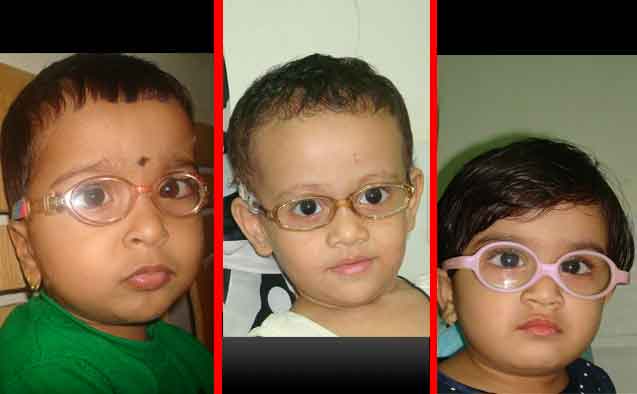
At Utsav Eye Clinic, we specialise in Squint Eye Treatment in Navi Mumbai, helping children and adults achieve straight, healthy eyes and better vision.
Have you noticed your child tilting their head to see clearly, or someone’s eyes not looking in the same direction? This may be a sign of squint eyes Even a small misalignment can make simple activities like reading, catching a ball, or pouring water harder. We help children and adults have straight, healthy eyes. Our goal is to make daily life easier, improve vision, and boost confidence. This guide will help you understand what squint is, how it affects everyday life, and the treatment options available.
Why Squint Happens
Squint happens when the eye muscles do not work together properly, causing one eye to drift. Common reasons include:
· Family history: Squint can run in families, so early eye checks are important.
· Farsightedness: Straining to focus can make the eyes turn inward.
· Health issues: Adults may develop strabismus, esotropia, exotropia, or complex eye problems due to stroke, diabetes, or nerve-related issues.
Finding squint early makes treatment easier and increases the chances of success.
How Squint Affects Daily Life
Squint can make everyday tasks harder for both children and adults.
· For children: They may tilt their head while reading, struggle in sports, or feel shy at school.
· For adults: Judging distances can be difficult, eyes may get tired quickly, and some people feel self-conscious in photos or social situations.
Even small eye misalignment can affect confidence. With proper care, children and adults can enjoy better vision and feel more confident.
Life After Squint Treatment
After treatment, life can improve in many ways. Children and adults can catch a ball without tilting their head, read comfortably without eye strain, and feel more confident in photos and social situations. Straightened eyes improve depth perception and vision, helping children feel confident at school while adults find daily activities easier.
Doctor’s Tips For Helping Your Child with Squint Eye Surgery
Here are practical tips from Dr. Anand Kumar for parents whose child is having squint surgery:
· Understand the procedure: Learn how the surgery works and what to expect.
· Follow pre-surgery instructions: Take medicines and follow fasting or eye care instructions.
· Support your child emotionally: Explain the surgery in simple words and stay calm to reduce anxiety.
· Post-surgery care: Use prescribed eye drops, keep eyes clean, and prevent rubbing.
· Attend follow-up appointments: Regular checkups help ensure proper healing and alignment.
· Gradually resume activities: After recovery, your child can return to reading, playing, and other routines.
Following these steps helps ensure a safe surgery, faster recovery, and better vision results.
Why Choose Utsav Eye Clinic?
Utsav Eye Clinic is a trusted centre for squint doctors in Navi Mumbai, lazy eyes, and complex eye alignment problems. The clinic provides personal care for children and adults, uses safe and modern treatment methods, and gives ongoing follow-up to maintain results. Many patients in Navi Mumbai choose Utsav Eye Clinic for its experienced specialists, and patients notice clear improvements in vision and quality of life.
Final Thought
Misaligned eyes, including cross eyes or lazy eyes, can affect vision, confidence, and daily life. With Dr. Anand Kumar at Utsav Eye Clinic, you or your child can start the journey toward clearer vision, better depth perception, and more self-confidence. Early checkups, proper treatment, and support at home can make a lasting positive difference
More
Early eye care is essential for children because healthy vision helps them learn, play, and grow with confidence. Good vision helps children learn, play, explore, and grow with confidence. Good vision helps children enjoy life, learn better, and grow with confidence. Clear sight supports reading, playing, exploring, and connecting with the world. Sometimes, though, one eye may not see as clearly as the other. This condition is called amblyopia, or lazy eye. It occurs when the brain relies more on one eye while the other becomes less active. Without proper care, the weaker eye can remain underdeveloped. But with early treatment, children can regain clear sight and enjoy this benefit for a lifetime.
When One Eye Works Less
Amblyopia is not always obvious in the beginning. A child may appear normal, but one eye slowly becomes weaker. There are many reasons for this. Some children have a squint, where the eyes are not aligned. Others may need glasses in children due to nearsightedness, farsightedness, or astigmatism. In rare cases, a cataract or another eye condition can lead to it.
Since children often don’t mention vision difficulties, parents might not notice anything unusual. The stronger eye usually works well, so the child adapts. This is why doctors often call amblyopia the “silent vision problem.”
Catching the Signs Early
Children’s eyes develop rapidly in the first few years of life. By the age of 7–8, most of their vision is already formed. Doing visual screening on children before this stage gives the best chance to detect lazy eye or squint in time.
Some simple signs parents can watch for are:
- Tilting the head often
- Covering one eye while reading
- Difficulty focusing on small objects
- One eye turning inward or outward
Even if no clear signs are noticed, scheduling an eye check is a wise step. Early treatment not only prevents complications but also supports learning and development at school.
Simple Steps That Make a Big Difference
Treating amblyopia is straightforward but requires patience and consistent follow-up.
- Glasses in children: Corrective glasses help both eyes work together.
- Eye patches: Covering the stronger eye helps the weaker one become stronger.
- Drops: In some cases, drops may be used instead of patches.
- Follow-ups: Regular checkups allow doctors to track progress and adjust treatment.
Extra Tips for Parents
- Make patching more enjoyable with colorful or themed patches.
- Encourage activities like drawing, puzzles, or reading while the patch is on.
- Praise your child for wearing glasses daily.
- Never miss follow up visits, as they are important to guide progress.
Small daily efforts can bring remarkable improvements in vision.
Care with Gentle Hands
At Utsav Eye Clinic, Kharghar,Navi Mumbai, Dr. Anand Kumar and his team treat amblyopia with kindness and expertise. Each child’s treatment plan is personalized with patience and care. From glasses to patching, every step is explained so that families feel confident and supported.
Final Thought
Every child deserves the gift of clear vision. Early care today builds confidence for school, play, and everyday life. A simple step now can give your child strong eyesight for years to come. Healthy eyes today, brighter tomorrow guided with care by Dr. Anand Kumar.
More
By Andy
23 Oct, 2014
Children Eye Care, Comprehensive Ophthalmology
Airoli, astigmatism, axis, CBD Belapur, cylinder, diopters, farsightedness, glasses, hyperopia, India, Kalamboli, Kamothe, kharghar, Mansarovar, myopia, navi mumbai, Nerul, New Panvel, Panvel, prescription, Sanpada, Seawoods, shortsightedness, spectacles, Vashi
Learn about your Glasses prescription
Glass prescription can be difficult to understand, especially when no one else in the family has worn glasses before. Most patients are puzzled by the ‘signs’ and ‘numbers’ on the glass prescription and would want to ask a lot of questions regarding it to the doctor, but are either too “shy” or they are gently “shoved out” of the consulting room for want of the doctor’s time.
This post will tell you most of the things that you need to know about your glass prescription.
But before that, let us review the common refractive error conditions.
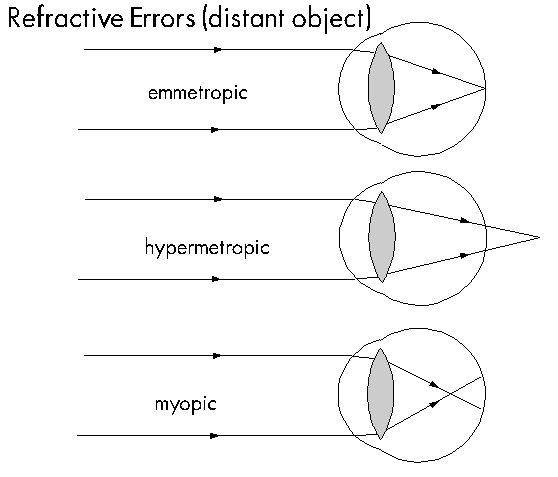 Farsightedness (Hyperopia)
Farsightedness, or hyperopia, as it is medically termed, is a vision condition in which distant objects are usually seen clearly, but close ones do not come into proper focus. Farsightedness occurs if your eyeball is too short or the cornea has too little curvature, so light entering your eye is not focused correctly.
Nearsightedness (Myopia)
Nearsightedness, or myopia, as it is medically termed, is a vision condition in which close objects are seen clearly, but objects farther away appear blurred. Nearsightedness occurs if the eyeball is too long or the cornea, the clear front cover of the eye, has too much curvature. As a result, the light entering the eye isn’t focused correctly and distant objects look blurred.
Astigmatism
Astigmatism is a vision condition that causes blurred vision due either to the irregular shape of the cornea, the clear front cover of the eye, or sometimes the curvature of the lens inside the eye. An irregular shaped cornea or lens prevents light from focusing properly on the retina, the light sensitive surface at the back of the eye. As a result, vision becomes blurred at any distance.
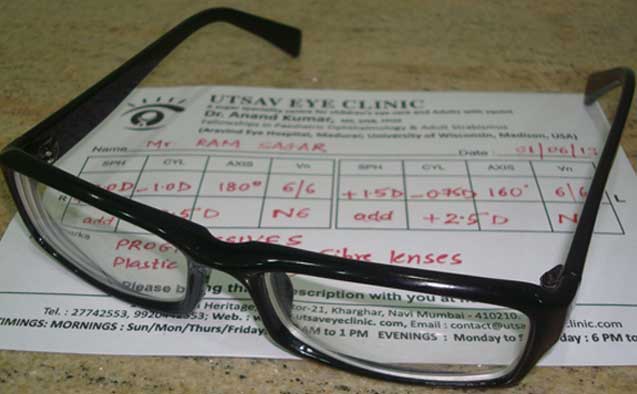
Sphere
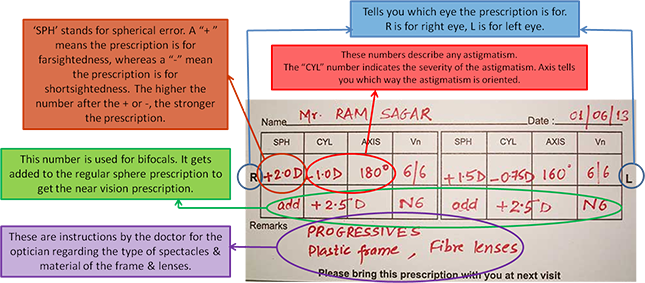
Sphere, often abbreviated as “sph” is the spherical refractive error, or nearsightedness or farsightedness. The first part of this number will be a plus or minus sign:
+ : farsighted, or longsighted prescription: hyperopia.
– : nearsighted, or shortsighted prescription: myopia.
0, Pl, or Plano : no error
How bad is the spherical prescription?
The number is in “diopters” but you don’t need to know too much about that, it’s a measure of how much the curvature of the eye is off from normal. Basically, the higher the number (ignoring the plus or minus), the worse the prescription.
Myopia (-)
0.00 to -3.00 : mild myopia
-3.00 to -6.00 : moderate myopia
-6.00 and higher : high myopia
Hyperopia (+)
0.00 to +2.25 : mild hyperopia
+2.25 to +5.00 : moderate hyperopia
+5.00 and higher : high hyperopia
Cylinder
Cylinder is the measure of astigmatism. Astigmatism is when there’s an irregular shape to the cornea, often described as a football shape. It causes blurriness at any distance. There are two measurements that go along with astigmatism, the first, cylinder, is a measure of how severe the astigmatism is.
How bad is the cylinder prescription?
Like the spherical error, the cylinder number is measured in diopters. The thing you want to pay attention to is the number. It may be written as a plus or a minus, but that doesn’t actually make any difference in how bad the prescription is. The higher the number after the plus or minus, the more severe the astigmatism.
0.00 to 1.00 : mild astigmatism
1.00 to 3.00 : moderate astigmatism
higher than 3.00 : severe astigmatism
Axis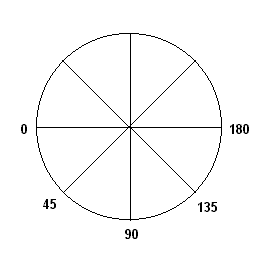
The axis tells you which way the astigmatism is oriented on your child’s eye
If you think of astigmatism as a football shape, it makes sense that the football might be turned any direction. The axis number then, tells you the orientation of the astigmatism. The number is in degrees, it doesn’t have anything to do with how severe the astigmatism is, just how it is situated on your or your child’s eye.
Add
If you or your child needs bifocals, you will likely see a number here. This tells you how the prescription should be changed for close up. Let’s say your child has a regular glasses prescription of +3.00, if the add number is +1.00, then the near distance prescription will be +3.00 + 1.00, which equals +4.00 (3+1=4). In the same vein, if your child is nearsighted, say -4.00, but has an add of +2.00, then the near distance part of the bifocals will have a prescription of -4.00 + 2.00, which equals -2.00.
Sometimes, you don’t have an “Add” part of the prescription, and instead you’ll just see a prescriptions for distance vision and a separate prescription for near vision.
Hope you got to learn something about your Glasses prescription. Please click on the LIKE button below to help your friends also read this.
Please do not hesitate to contact us for any queries or feedback.
Adapted from littlefoureyes
More
By Andy
23 Oct, 2014
Children Eye Care, Uncategorized
Airoli, CBD Belapur, child eye doctor, child eye specialist, children, children eye doctor, children eye specialist, far-sightedness, glasses, hypermetropia, hyperopia, India, Kalamboli, Kamothe, kharghar, Mansarovar, myopia, navi mumbai, Nerul, New Panvel, Panvel, Sanpada, Seawoods, short-sightedness
Getting the glasses to stay on
Many Eye specialist doctors will tell you that once your child realizes that they see better with their glasses, they’ll be much more likely to leave them on, and even ask for them first thing in the morning. And that’s true, but the trick is getting through that initial stage when they don’t want these funny things sitting on their face.
Every child is different, some will take to their glasses immediately, while others fight tooth and nail for months. A recent poll shows that about 65% children were wearing them well in a week or less, but more than 15% of the kids take longer than a month before they’ll wear them reliably. Odds are your child will surprise you and take to their glasses quickly, but if they don’t, know that you’r not alone in your struggles.
While there are a lot of strategies to get your child to leave their glasses on, the key seems to be to stay calm and positive (which is easier said than done) and consistent about keeping them on (ok, this is also easier said than done). When your child takes them off, put them back on with a smile, but don’t make a big deal about it. If they are really fighting or upset, set the glasses to the side for a few minutes until your child calms down and try again. You’ll also want to have activities on hand when you put those glasses on. Boredom and glasses do not mix!
The following strategies have been suggested by parents of our kid patients who needed to wear glasses. They may help you in your struggle to make your children keep on their glasses too.
- Talk about how nice he or she looks in the glasses.
- When putting glasses on your child, do it with a smile. “While we were trying glasses on Palak, she was crying and we were getting upset, too, and we kept apologizing to her. Dr. Kumar recommended that instead, we show her how happy we are when we put glasses on her (even when we aren’t). It didn’t completely stop her crying, but she definitely calmed down a notch once we started acting happier” says Mrs. Shah, the mother of a 7 year cheerful girl residing in Kharghar.

- Show them glasses-wearing characters (like Arthur, or Harry Potter for older kids). This helps them accept the glasses by making them less self-conscious.
- If your child keeps taking off their glasses, simply put them back on with a smile. If they don’t let you put them on, don’t make a big deal, simply set them aside and try again in a few minutes. “It took about 2 weeks for Zeeshan to get to a point where he leaves the glasses on most of the time” says Mrs. Chaudhary, a resident of Nerul, Navi Mumbai.
- Most kids, especially teenagers are conscious about their looks particularly in front of their school mates. Hence it may be a good idea to speak to the class teachers and close friends and ask them to appreciate the child’s new look.

- When she put on her pair of glasses, I rewarded her with her favorite cookies and explained that each times she wears her glasses we’ll show her how proud we are by giving her a cookie. She seems motivated by this and put them on 4 more times before dinner.
- Take off your child’s glasses when they’re in the car – at least at the beginning. It’s likely they’ll take off their glasses and throw them somewhere where they might fall out of the car or get smushed when you open the door.
- Mrs. Tawade of New Panvel thinks the reward system works best for most kids. She says “We bribed him with a new Thomas toy if he would put them on and leave them alone, so he did, and Daddy let him pick out the most expensive Thomas set that the store had.”
We wish you the best in your efforts to make your child keep their glasses on. If you have any strategy that has worked for you, kindly share it with us for the benefit of other parents.
More
Why do I need to see a Paediatric Eye Doctor in Navi Mumbai?
The American Academy of Paediatrics states that “Children are not just small adults. They cannot always say what is bothering them. They cannot always answer medical questions, and are not always able to be patient and cooperative during a medical examination.” The examination techniques used to examine the eyes in adults do not work well with kids. Paediatric Eye Doctor in Navi Mumbai.
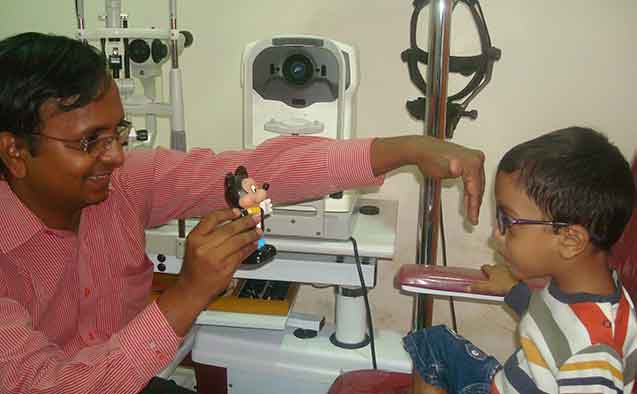
 Paediatric ophthalmologists (Children Eye Care doctors or Paediatric Eye doctors) know how to examine and treat children in a way that makes them relaxed and cooperative. In addition, paediatric ophthalmologists use equipment specially designed for children. Most paediatric ophthalmologists’ clinics are arranged and decorated with children in mind. This helps create a comfortable and joyful environment for your child. Our examination room at Utsav Eye Clinic, Kharghar, Navi Mumbai are child-friendly and are designed to make your child relaxed while we conduct the eye examination in a breeze. Dr Kumar of Utsav Eye Clinic is one of the few fellowship trained Paediatric Eye Doctor in Navi Mumbai.
Paediatric ophthalmologists are medical doctors who have had
• Four and half years of medical school (MBBS)
• One year of medical or surgical internship
• Three additional years of residency training in ophthalmology (MS)
• One and half additional year of fellowship training in paediatric ophthalmology (FPOS)
• Dr. Anand Kumar has also undergone an advanced fellowship training at the University of Wisconsin, Madison, USA in speciality of paediatric ophthalmology and strabismus (FPOS).
Paediatric Eye Doctors have expertise to treat the following eye conditions:
- Amblyopia (lazy eye)
- Blocked tear ducts
- Cataracts
- Conditions requiring oculoplastic surgery
- Conditions requiring vision therapy evaluation
- Congenital cranial dysinnervation disorders
- Eye tumors
- Hemangiomas and lymphangiomas of the eye and orbit
- Infections and inflammations of the eye and orbit
- Neuro-ophthalmological conditions
- Pediatric corneal disease
- Pediatric / juvenile glaucoma
- Ptosis (droopy eyelids)
- Refractive errors (glasses in children)
- Retina disorders that lead to vision loss
- Retinoblastoma
- Retinopathy of prematurity
- Strabismus (misaligned or crossed eyes)
- Strabismus caused by thyroid disease, stroke, injuries and cancer
- Strabismus in adults
- Tearing eyes
- Traumatic eye injuries
To know more about our Child Eye care and squint specialist at Utsav Eye Clinic, Kharghar click here.
More
Glasses in children
Having trouble selecting the “right” glasses for your kids?
Read these tips before making up your mind.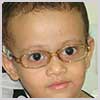
- It is especially important for children’s eyeglasses to stay in place, because when eyeglasses slide down the nose, kids tend to look over the tops of the lenses instead of pushing them back up where they belong.
-
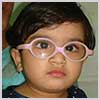 Plastic or Metal Eyeglass Frames?
Plastic used to be and still is the recommended material for kids’ glasses. It is considered to be more flexible, yet sturdier, and the perfect choice for frames on an active child. Though metal eyeglass frames, or “wire frames” as they are often called, have gotten a bad rap in the past, today’s glasses are made tough to handle the abuse that children give them. There are several types of metal eyeglass frames for kids, including Monel, Stainless Steel, Aluminum, Nickel Silver, and Titanium. These metals can be formed into stylish, yet lightweight frames. In order to properly choose the best temples for your kid’s glasses, the temples should actually wrap around their ears.
- And finally, if your child needs to wear eyeglasses all the time to see, it would be a good idea to check into purchasing a second pair to use as a spare.
When in doubt about a frame’s fit, do not hesitate to consult the optician.
They would be able to answer your queries regarding glasses in children.
More
Follow these tips to ensure healthy eyes for your children.
 1. Diet: A normal balanced diet comprising of red and green leafy vegetables like spinach, carrots, beetroot and yellow fruits including mango and papaya which are rich in carotene (A precursor of Vitamin A) should be consumed by children for healthy eyes.
2. TV Viewing: Television should be watched at a proper viewing distance of 3.5 meter or more in a well-lighted room. The bigger the TV, the further away your child should sit.
 3. Computer Usage: the child should be encouraged to use it judiciously in order to reduce eye fatigue. Computer screen should be slightly lower than the eye level. Encourage your child to take a break after 30-40 minutes of near work such as reading, writing or computer work. Your child should look at distant objects for 3 to 5 minutes. They could look out of the window into the distance.
4. Playing games on the mobile: phones should be restricted because of the less form factor and the resolution.
5. Lighting: One should have a light source behind or from the side while studying. Books should be held at about 14 inches distance.
6. Outdoor activities: Protective eye wear is recommended for children involved in contact sports. Encourage children to spend more time on outdoor activities like ball games, walks in the park or a family picnic at the beach, as there is emerging evidence that outdoor activities may delay the onset or progression of myopia in your child.
8. Allergic Conjunctivitis is frequently seen in school age, children should be discouraged from rubbing their eyes since it aggravates the allergic process, In addition, due vigilance has to be paid to eye hygiene. Children should not touch their eyes with dirty hands
9. Certain practices like application of Kajal to new-borns and washing eyes with rosewater is an absolute NO-NO.
10. Take your child for eye checkups yearly
Click here to Read more about Utsav Eye Clinic.
More