Most people these days are increasingly using Digital devices. These include IT professionals who are working from home (WFH) and school students who are attending online classes.
There are chances of developing eye and vision problems due to this increase in Screen time. This results in digital eye strain or computer vision syndrome. These effects are more pronounced and harmful in children.
Symptoms of Digital Eye Strain:
Pain & discomfort
Blurred vision
Burning sensation in the eyes
Squint and double vision
Increase in Myopia (Short sightedness)
At Utsav Eye Clinic Kharghar, we understand that gadgets are already a part of daily life. Your favorite Eye specialist in Kharghar, Dr Anand Kumar shares five tips on preventing Digital Eye Strain.
1) Take Regular breaks
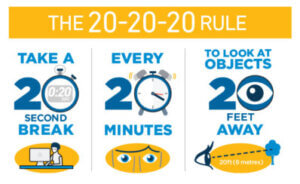
If you have to spend prolonged periods in front of your computer, we encourage you to practice the “20-20-20” rule. For every 20 minutes, you should look at an object 20 feet away for 20 seconds. We also recommend blinking exercises to prevent dryness of your eyes. If needed, do not hesitate to visit your Ophthalmologist who may prescribe lubrication eyedrops to prevent digital eye strain.
2) Adjust Computer screen settings
Increase the font size of the screen
Adjust the screen brightness, contrast and resolution for increasing comfort of reading.
You may also have anti-glare screens attached to your monitor.
The room should be adequately lit. Avoid using a computer or mobile phone in the dark.
3) Choose Larger Screens
Smaller and brighter screens lead to more eye strain. Whenever possible children should read or attend online classes on a desktop or laptop computer rather than a mobile phone to prevent digital eye strain.
4) Prevent Sleep disturbances
Keep your Digital devices away from the bed room to maintain a healthy sleep pattern. Switch off all your digital devices atleast one hour before your scheduled sleep time.
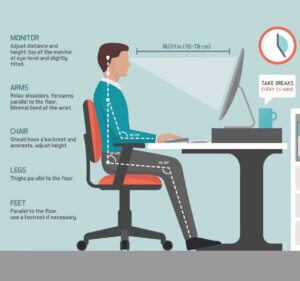
5) Observe Proper Posture
We recommend adjusting your chair at eye-level with your monitor when using your computer. This ensures that your head and neck are upright. You may also use a chair that provides lower back support and a cushioned seat to ensure comfort.
Discuss with your Eye Specialist whether you would be benefitted by using some eye drops or Computer glasses.
At Utsav Eye Clinic, our eye doctors have the knowledge, expertise, and instruments to help you with your eye care needs. From comprehensive eye exams to Advanced Cataract Surgery in Kharghar we have the full range of services to help you.
Call us today at 022 35569270 to schedule an appointment so that we can help protect your eyes from digital eye strain.
The National Eye Donation Fortnight is observed every year from 25thAugust to 8th September. The aim of the campaign is to create mass public awareness about the importance of eye donation and to motivate people to pledge their eyes for donation after death.
What is Eye Donation?
Eye donation is an act of donating one’s eyes after his/her death. People who are visually impaired due to corneal disease can be benefited. It is an act of charity, purely for the benefit of the society and is totally voluntary. It is done after death. So eye-donation should be encouraged as one of the best means of social service. To enable another person obtain vision is one of the best forms of charity. Even after death the donor lives in the eyes of recipient. Eyes from a dead person can enable two blind people to acquire vision.
What is the use of eyes received?
The eyes, which are received through such magnanimous gestures, are of great benefit to the society. The front, clear and transparent tissue of the eye called as cornea can be used to restore vision to corneal blind person. The other portions of the eye are also used for research and training purposes to develop cures for some of the common eye diseases.
What is Corneal Blindness?
The Cornea is the clear tissue covering the front of the eye. It is a focusing element of the eye. The Vision is dramatically reduced or lost if the cornea becomes cloudy. This loss of the vision is referred as corneal blindness.
Is there a cure for corneal blindness?
Yes. Removing the damaged cornea and replacing it with a healthy cornea by surgery can cure corneal blindness. Till date the treatment of the corneally blind people is corneal grafting. Artificial corneas have not yet been developed and hence the only source for cornea is from our fellow human beings.
How can one donate eyes?
The eyes of a dead person can be used only if they are taken out within 6 hrs of death. When a person who has given consent for the donation of one’s eyes dies, the eye should be kept wet by sprinkling water on them. Otherwise pieces of cotton wool soaked in water should be placed on both the eyes so that the cornea does not become dry till the eye-surgeon arrives. After the removal of the eyes the eyelids will be stitched together and there will be no visible sign of the eyes having been removed. The entire process is completed within 10-15 mins, therefore if one pledged to donate his eyes after death, it is the duty of his relatives to inform to the nearest eye bank after his death.
After the removal of eyes, would there be any complications or disfigurement?
There are two methods adopted for removal of eyes. Some eye banks would remove the whole eyeball. In such a case there may be temporary bleeding. The team is well trained to take care of such eventualities. There would be no disfigurement. The eye bank team, after the removal of eyes would properly close the eyes so that there is no disfigurement. The second method is the removal of only the clear transparent tissue. Here also a plastic shield is placed in place of the tissue and no difference can be noticed.
Is eye donation against religious principles or traditions?
All religions endorse eye donation. There are numerous examples in our traditions and scriptures, which endorse eye and organ donation. A part of the body would be consumed by flames and reduced to ashes or which is buried and allowed to decay and disintegrate & cannot be put to a better use than restoring vision to the needy.
Am I too old/young to be an eye donor?
No. There is generally a use for eyes of any age.
Can the eyes of the individuals having diabetes, hypertension be donated?
Yes. People with systemic diseases can also donate eyes.
Who cannot donate their eyes?
Patients suffering from Rabies, Tetanus, Aids, Jaundice, Cancer, Gangrene, Brain Tumor, Food Poisoning, Septicemia & a person who has died due to drowning etc. cannot donate their eyes.
Diwali is the festival of light. Perhaps its most iconic celebration is the colorful and dazzling display of fireworks that lights up the night sky. As beautiful as it looks, fireworks account for thousands of emergency room visits each year during the festival. The majority of injuries that impact eye health occur in bystanders. In fact, the eyes are the second-most common affected area after the hands and fingers. As expected, the leading cause of injuries on Diwali is the lack of appropriate safety measures while lighting fireworks.
Due to serious issues like eye health and safety risks involved, medical experts strongly discourage firework play of any kind. A safer alternative is watching authorized laser and firework displays operated by licensed professionals. But if you still want to use fireworks as part of your celebrations, please ensure you take the following safety precautions at all times:
*Store fireworks in a closed box in a safe location, away from the reach of children
*Avoid sparklers that reach temperatures as high as 1000°C – high enough to melt gold and cause serious injury
*Keep fireworks away from the face, hair, and clothing
*Maintain a distance of an arm’s length while lighting firecrackers, and at least five meters while watching
*Defuse used fireworks properly by soaking them in a bucket of water before disposal
In case of an accident, contact emergency medical services immediately. Do not rub, rinse or apply ointment to the eye. It may make the injury worse or difficult to examine.
By taking these simple precautions for good eye health, you will be able to enjoy fireworks on Diwali without worrying about the safety of your loved ones. Happy celebrations!
We often get asked various questions by patients visiting our Clinic about cataracts, how they develop, the cost of Cataract Surgery, the treatment for “getting rid” of them and the recovery period required after surgery. Here are our five most common myths surrounding cataracts and the facts as uncovered by our Cataract Specialist in Kharghar Navi Mumbai, Dr Anand Kumar.
Myth 1: Eye drops can get rid of cataracts
FACT: Pharmaceutical companies promote many eye drops as cure for cataract. However there is no good evidence from clinical studies that any eye drop can cure cataracts to date. The only proven treatment for cataracts is Cataract Removal.
Myth 2: Cataracts are reversible
FACT: Cataracts occur due to age related changes in your natural lens. These changes are not reversible with time, drops or tablets. The only way to treat cataracts is to remove the cloudy lens with surgery and replace it with a clear artificial lens called as intra-ocular lens (IOL).
Myth 3: Cataracts must be ripe before operating on them
FACT: This myth may have arisen from the fact the cataract surgery was more risky in the past. The risk may not have been taken because of the potential complications of cataract surgery. Thankfully cataract surgery is far safer nowadays and we can safely operate on patients who have symptoms – however mild or severe. Waiting for cataracts to ripen or mature may actually make cataract surgery more technically challenging and potentially more risky, so it’s not a normal practice to wait for the cataracts to ripe.
Myth 4: Recovery after Cataract Surgery takes months
FACT: With the latest technology and advanced surgical techniques, cataract surgery recovery has been dramatically reduced. It is true that in the past cataract patients were admitted for a week before surgery, their surgical time could be more than an hour and the recovery time was spent in hospital for many days. The main reasons why we don’t have to do this anymore, is that our skills and technology are more advanced now, the wounds we create are much smaller without the need for stitches and our dramatic reduction in infection rates due to preventative antibiotics that are placed in the eye at the end of cataract surgery. At Utsav Eye Clinic, we practice No injection, No pad technique for cataract surgery which makes the surgery even more comfortable and safe.
Myth 5: Only old people develop cataracts
FACT: While it is true that if most people live long enough, they will eventually get cataracts, not all people with cataracts are greater than 60 years of age. Cataracts are seen in all age groups – even newborns born with congenital cataracts. Nowadays even younger people are getting cataracts, maybe due to our changing lifestyles. Take our FREE Cataract self assessment test to find out if you have cataracts.
Make an appointment with our Cataract Specialist in Kharghar Navi Mumbai by filling the adjoining form or call us on 022-27742553, 9920442553.
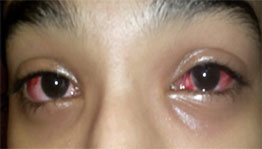
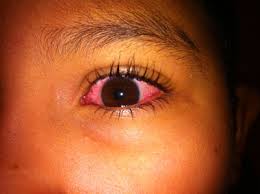
Viral Conjunctivitis is an inflammation (swelling) of the conjunctiva (the outermost transparent covering of the white of the eye and the inside of the eyelids) in the eye. This inflammation may lead to redness, tearing, discharge, itching, and pain.
How does Viral Conjunctivitis spread?
Viral Conjunctivitis epidemics tend to occur in closed institutions (eg, schools, hospitals, camps, nursing homes, workplaces).
Direct contact with eye secretions is the major mode of transmission. This can happen by touching the hands of someone with the infection, or by touching contaminated surfaces or objects.
Other possible methods of transmission are air droplets and possibly swimming pools. The virus causing the infection can be recovered from the eye and throat for as long as 14 days after the onset of clinical symptoms.
What are the symptoms of Viral Conjunctivitis?
Typically, patients initially complain of an increasingly severe gritty sensation in one eye, starting from the nasal corner of the eye and spreading laterally. This is followed by marked lid swelling, tearing, itching, increased light sensitivity, and blurred vision. Similar, but usually much milder, manifestations commonly appear in the other eye in two to seven days.
The severity of Viral Conjunctivitis ranges from subclinical conjunctivitis to very severe disease with bacterial superinfection and with marked systemic symptoms such as generalized weakness and pain in the limbs. The involvement of the second eye is often so mild as to go unnoticed. A small painful lump in front of the ears may arise in some patients.
How can Viral Conjunctivitis be prevented?
To avoiding spreading Viral conjunctivitis (EKC), patients should be very careful not to touch others and not to share tissues, towels, or handkerchiefs and to wash their hands frequently as long as the eye is red. In fact, Hand washing by patients and their contacts has been considered the most effective measure for preventing transmission of the microorganism.
Children who are suffering from this infection should stay home from school until symptoms have resolved or until cleared by a doctor.
Patients who have Viral Conjunctivitis should follow the below mentioned measures religiously
They should avoid touching their eyes whenever possible. If they do touch their eyes, they need to wash hands thoroughly with soap and running water
They should use disposable tissues to wipe their eyes, blow their nose, sneeze or cough.
Patients should avoid touching other people un necessarily
They should throw away or carefully wash items (in hot water and detergent) that touch their eyes
They should not share eye makeup or other items used on the eyes (e.g., towels, tissues, eye drops, eye medications)
Use a separate towel and face cloth for each member of the household
Cover your mouth and nose when coughing or sneezing.
How is Viral Conjunctivitis treated?
There is no definitive treatment available for viral conjunctivitis. It is a self resolving condition in most cases and goes away in about 1-2 weeks. Treatment is aimed to relieve the symptoms and prevent added super infection. Avoid self medication and use of over the counter medicines. Some of these medicines may do more harm than good.
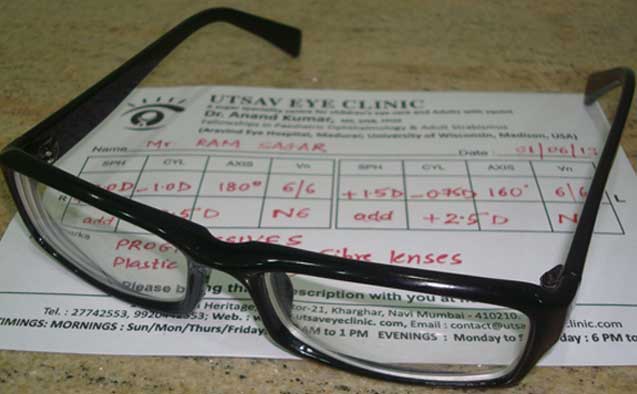
Glass prescription can be difficult to understand, especially when no one else in the family has worn glasses before. Most patients are puzzled by the ‘signs’ and ‘numbers’ on the glass prescription and would want to ask a lot of questions regarding it to the doctor, but are either too “shy” or they are gently “shoved out” of the consulting room for want of the doctor’s time.
This post will tell you most of the things that you need to know about your glass prescription.
But before that, let us review the common refractive error conditions.
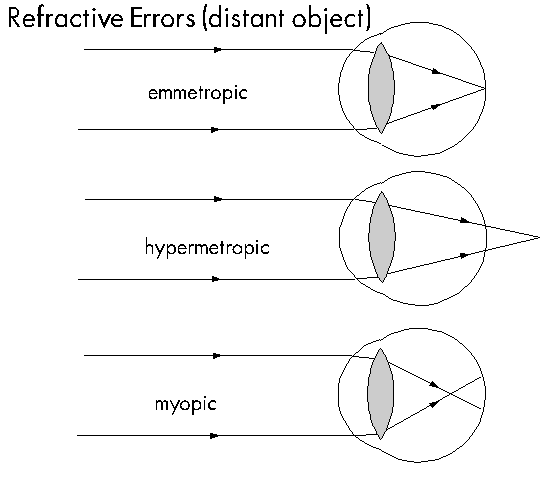
Farsightedness (Hyperopia)
Farsightedness, or hyperopia, as it is medically termed, is a vision condition in which distant objects are usually seen clearly, but close ones do not come into proper focus. Farsightedness occurs if your eyeball is too short or the cornea has too little curvature, so light entering your eye is not focused correctly.
Nearsightedness (Myopia)
Nearsightedness, or myopia, as it is medically termed, is a vision condition in which close objects are seen clearly, but objects farther away appear blurred. Nearsightedness occurs if the eyeball is too long or the cornea, the clear front cover of the eye, has too much curvature. As a result, the light entering the eye isn’t focused correctly and distant objects look blurred.
Astigmatism
Astigmatism is a vision condition that causes blurred vision due either to the irregular shape of the cornea, the clear front cover of the eye, or sometimes the curvature of the lens inside the eye. An irregular shaped cornea or lens prevents light from focusing properly on the retina, the light sensitive surface at the back of the eye. As a result, vision becomes blurred at any distance.
Sphere
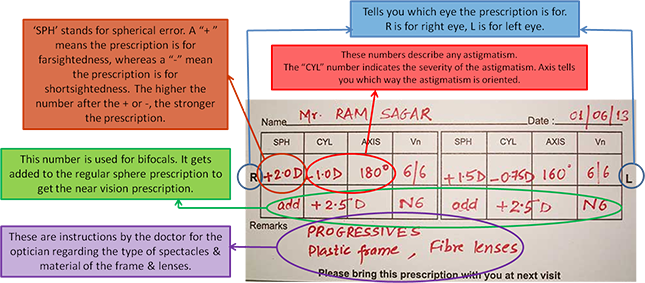
Sphere, often abbreviated as “sph” is the spherical refractive error, or nearsightedness or farsightedness. The first part of this number will be a plus or minus sign:
+ : farsighted, or longsighted prescription: hyperopia.
– : nearsighted, or shortsighted prescription: myopia.
0, Pl, or Plano : no error
How bad is the spherical prescription?
The number is in “diopters” but you don’t need to know too much about that, it’s a measure of how much the curvature of the eye is off from normal. Basically, the higher the number (ignoring the plus or minus), the worse the prescription.
Myopia (-)
0.00 to -3.00 : mild myopia
-3.00 to -6.00 : moderate myopia
-6.00 and higher : high myopia
Hyperopia (+)
0.00 to +2.25 : mild hyperopia
+2.25 to +5.00 : moderate hyperopia
+5.00 and higher : high hyperopia
Cylinder
Cylinder is the measure of astigmatism. Astigmatism is when there’s an irregular shape to the cornea, often described as a football shape. It causes blurriness at any distance. There are two measurements that go along with astigmatism, the first, cylinder, is a measure of how severe the astigmatism is.
How bad is the cylinder prescription?
Like the spherical error, the cylinder number is measured in diopters. The thing you want to pay attention to is the number. It may be written as a plus or a minus, but that doesn’t actually make any difference in how bad the prescription is. The higher the number after the plus or minus, the more severe the astigmatism.
0.00 to 1.00 : mild astigmatism
1.00 to 3.00 : moderate astigmatism
higher than 3.00 : severe astigmatism
Axis
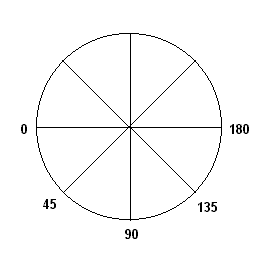
The axis tells you which way the astigmatism is oriented on your child’s eye
If you think of astigmatism as a football shape, it makes sense that the football might be turned any direction. The axis number then, tells you the orientation of the astigmatism. The number is in degrees, it doesn’t have anything to do with how severe the astigmatism is, just how it is situated on your or your child’s eye.
Add
If you or your child needs bifocals, you will likely see a number here. This tells you how the prescription should be changed for close up. Let’s say your child has a regular glasses prescription of +3.00, if the add number is +1.00, then the near distance prescription will be +3.00 + 1.00, which equals +4.00 (3+1=4). In the same vein, if your child is nearsighted, say -4.00, but has an add of +2.00, then the near distance part of the bifocals will have a prescription of -4.00 + 2.00, which equals -2.00.
Sometimes, you don’t have an “Add” part of the prescription, and instead you’ll just see a prescriptions for distance vision and a separate prescription for near vision.
Hope you got to learn something about your Glasses prescription. Please click on the LIKE button below to help your friends also read this.
Please do not hesitate to contact us for any queries or feedback.