At What Age Should Children Get Their First Eye Exam?
Welcome to Utsav Eye Clinic's guide on At What Age Should Children Get Their First Eye Exam?. Led by Dr. Anand Kumar, our clinic provides advanced pediatric eye specialist in Navi Mumbai to help patients maintain clear, comfortable vision. Call us at 022 35569270.
Why Early Childhood Vision Testing is Critical
A child's vision does not develop fully at birth; instead, the brain learns how to use the eyes to see during the first few years of life. If a visual problem (such as a squint, high refractive error, or cataract) is present and goes uncorrected, it blocks clear visual inputs to the brain. This halts visual pathway development, causing permanent lazy eye (amblyopia). Because young children do not know what normal vision is, they rarely complain about sight problems. A child with poor vision in one eye will function completely normally using the other eye, making it impossible for parents to detect the problem without a professional eye exam. Early screening is the only way to prevent permanent vision loss.
Infant Eye Screenings (0 to 12 Months)
Every newborn should have their eyes checked in the hospital nursery for major structural defects, pupil reactions, and the "red reflex" (which rules out pediatric cataracts or retinoblastoma). An infant should undergo a detailed pediatric eye exam between 6 to 12 months of age. During this stage, the pediatric eye specialist checks for proper tracking, focus, eye alignment, and uses a retinoscope to screen for significant nearsightedness, farsightedness, or astigmatism.
Toddler and Preschooler Exams (Ages 1 to 3)
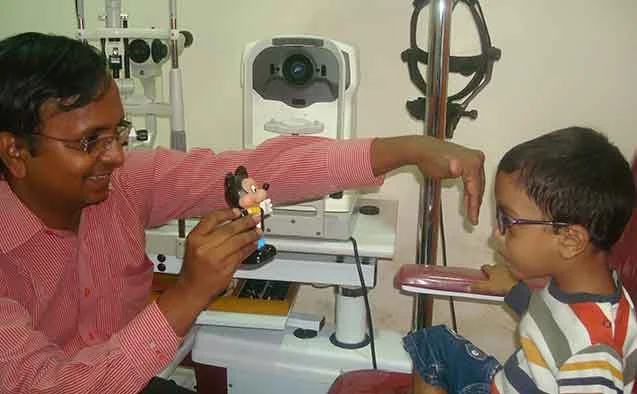
Between ages 1 and 3, children become more mobile and visual demands increase. An eye exam during this period ensures that binocular (two-eyed) vision is developing normally and rules out early-stage squints or lazy eye. Pediatric ophthalmologists use specialized toys, lights, and matching cards to assess visual functions even if the child is non-verbal or uncooperative.
Pre-School and School-Age Checkups (Ages 3 to 5+)
A critical vision checkup is recommended at age 3 and again at age 5 before entering school. At this stage, visual acuity is measured using kid-friendly charts (like LEA symbols or tumbling Es). We also check for color vision, depth perception, and binocular alignment. A child needs sharp, comfortable vision to read, write, and see the school board. Undetected refractive errors are a common cause of poor school performance and behavioral issues.
Warning Signs That Indicate an Immediate Eye Check
You should schedule an immediate consultation at Utsav Eye Clinic if your child exhibits any of the following symptoms:
• Sitting too close to the television or holding books/devices near their face.
• Frequent eye rubbing, squinting, or excessive blinking.
• One eye drifting inward, outward, or upward (squint).
• Tilting their head to one side when looking at objects.
• Excessive tearing or light sensitivity.
• Complaining of headaches, eye strain, or double vision.
Frequently Asked Questions (FAQ)
How can you test a child's vision if they do not know the alphabet?
Pediatric ophthalmologists use specialized non-verbal testing charts featuring symbols (like apples, houses, shapes), matching cards, and light reflection tools to accurately measure vision in toddlers.
Is pupil dilation safe for babies?
Yes. Pupil dilation using gentle, pediatric-strength dilating drops is safe and essential. It allows the doctor to examine the retina and optic nerve, and measure refractive power accurately.
How often should a school-age child have their eyes examined?
If your child does not need vision correction, a checkup every 2 years is recommended. Children who wear glasses should have their eyes examined every 6 to 12 months.
Can a pediatrician perform a comprehensive eye exam?
Pediatricians perform basic vision screenings, but they do not have the specialized equipment or training to conduct dilated eye exams or diagnose complex ocular alignment issues.
What is the most common vision problem in children?
Refractive errors (nearsightedness, farsightedness, and astigmatism) are the most common pediatric vision issues, followed by lazy eye (amblyopia) and squint (strabismus).
Why does my child need a dilated eye test?
Dilation relaxes the child's focusing muscles, allowing the ophthalmologist to measure the exact refractive power of the eye and thoroughly examine the health of the retina and optic nerve.

MBBS, MS (Ophthalmology), Fellowship in Pediatric Ophthalmology & Strabismus (USA). Chief Surgeon & Director at Utsav Eye Clinic.