
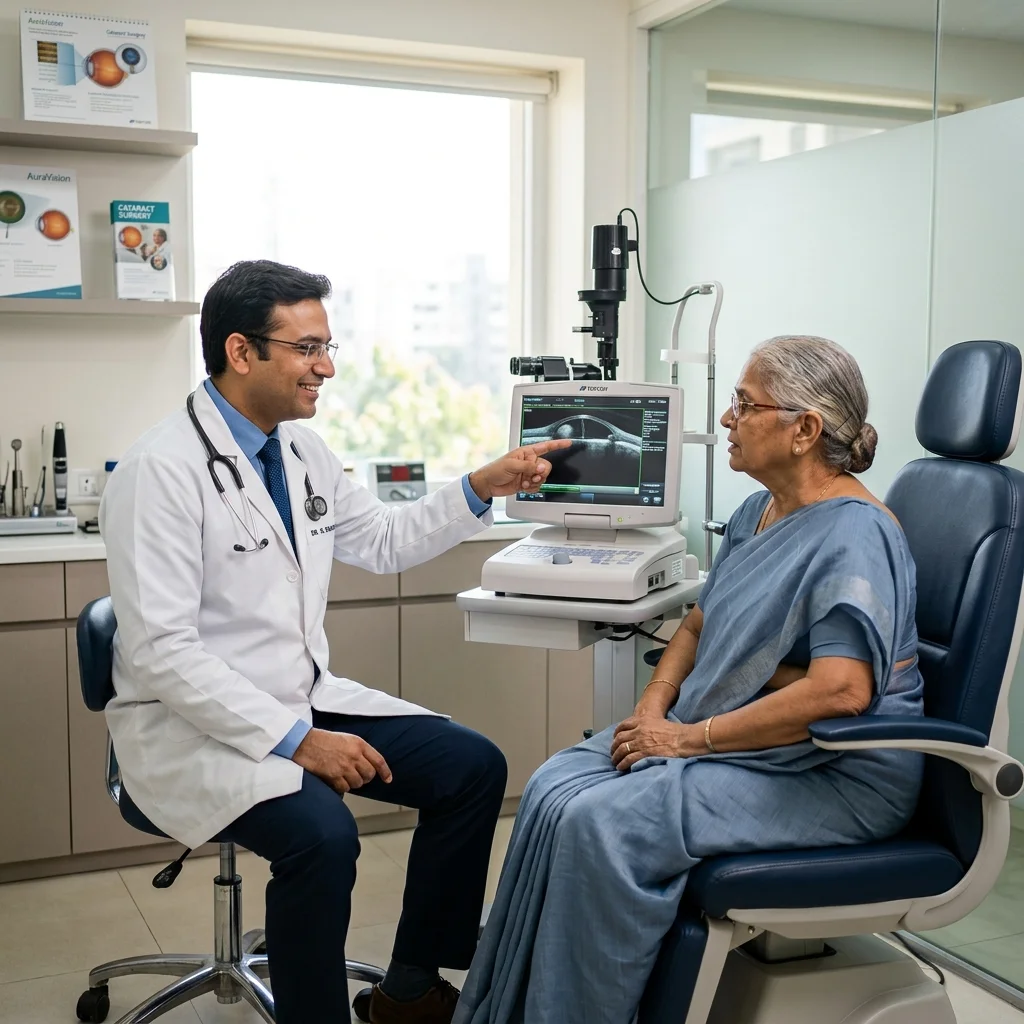
Advanced Cataract Surgery in Kharghar, Navi Mumbai
Cataract surgery in Kharghar, Navi Mumbai at Utsav Eye Clinic is performed using state-of-the-art Micro-Incision Cataract Surgery (MICS) via phacoemulsification. Led by Dr. Anand Kumar, a fellowship-trained eye specialist, our clinic offers premium monofocal, multifocal, EDOF, and toric intraocular lens (IOL) options. The daycare procedure is stitchless, painless, and ensures quick visual recovery. Call 022 35569270.
Cataracts represent one of the most common causes of visual impairment worldwide, particularly in individuals over the age of 50. When the natural lens of your eye becomes cloudy, it makes daily activities like reading, driving, and recognizing faces challenging. At Utsav Eye Clinic, we combine surgical expertise with the latest medical technologies to deliver safe, effective, and life-changing cataract solutions to patients in Kharghar, Belapur, Vashi, and across Navi Mumbai.
What is a Cataract? (A Detailed Medical Explanation)
Inside the human eye, there is a natural crystalline lens that acts very much like a camera lens. It focuses light rays onto the retina at the back of the eye, producing a clear, sharp image. The natural lens is composed primarily of water and proteins arranged in a precise pattern that maintains optical clarity.
As we age, metabolic changes within the eye cause these lens proteins to degrade and clump together. This process is largely driven by oxidative stress, ultraviolet radiation exposure, and normal aging processes. This clumping forms opaque areas on the lens, which we refer to as a **cataract**. The cataract acts like a dirty, frosted window, scattering light instead of focusing it. As a result, the images sent to the brain become progressively blurred, distorted, and dimmed. Without treatment, cataracts continue to expand, eventually leading to severe vision loss or blindness.
Types of Cataracts
While aging is the primary driver of cataract formation, cataracts can manifest in several ways based on their underlying cause, position in the lens, and rate of progression:
- Nuclear Sclerotic Cataracts: The most common form, developing gradually in the center (nucleus) of the lens, causing it to harden and yellow. This often results in a temporary improvement in near vision (called "second sight"), which eventually declines. It is highly associated with aging.
- Cortical Cataracts: These start as white, wedge-like streaks or spokes on the outer edge (cortex) of the lens and slowly extend toward the center, disrupting light passing through the periphery. Patients with cortical cataracts often experience significant glare.
- Posterior Subcapsular Cataracts: These develop at the very back of the lens capsule, directly in the path of light. They progress much faster than other types and cause significant glare, particularly in bright sunlight or night driving. This type is common in diabetic patients and steroid users.
- Congenital Cataracts: Cataracts present in babies at birth or during early childhood, arising from genetic factors, intrauterine infections (such as rubella), or metabolic disorders. These require immediate pediatric intervention to avoid lazy eye.
- Secondary/Traumatic Cataracts: Developing as a result of physical eye injury, intraocular inflammation, steroid use, radiation, or underlying systemic conditions like diabetes. A traumatic cataract can develop quickly after a blunt or penetrating eye injury.
Common Symptoms of Cataracts
Cataracts develop slowly over several months or years. In the early stages, you may notice only minor changes in your sight. However, as the cloudiness expands, typical symptoms include:
- Gradual, painless blurring or dimming of vision, making it feel like you are looking through a sheet of wax paper.
- Increased sensitivity to light, glare, and bright headlights, causing significant discomfort during night driving.
- Appearance of "halos" or rings around light sources, which is particularly prominent in dark environments.
- Frequent changes in eyeglasses or contact lens prescriptions, as the yellowing lens alters the eye's focal power.
- Colors appearing faded, dull, or yellowish, making it difficult to distinguish blues from purples.
- Double vision in a single eye (monocular diplopia).
- Difficulty reading in low light, requiring brighter reading lamps.
When is Cataract Surgery Recommended?
Many patients ask, "Does my cataract need to be ripe or hard before surgery?" The answer is **no**. In the past, older surgical methods required cataracts to reach an advanced stage before removal. With modern micro-surgical techniques, waiting is no longer necessary or recommended. In fact, removing a hard, over-mature cataract requires more ultrasound energy, increasing surgical risks.
You should consider cataract surgery when the visual impairment begins to interfere with your quality of life and routine activities, such as:
- Inability to drive safely at night due to glare and halos from oncoming headlights.
- Difficulty reading books, using smartphones, or working on a computer screen.
- Increased risk of falls or loss of balance due to poor depth perception and reduced contrast sensitivity.
- Inability to perform hobbies like sewing, cooking, or playing outdoor sports.
- Inability to pass standard driving license vision examinations.
Types of Cataract Surgery Offered
At Utsav Eye Clinic, we offer advanced, stitchless, and patchless daycare cataract surgery using the latest micro-incision techniques:
-
1. Phacoemulsification (Phaco):
The standard of care worldwide. A tiny incision (2.2 to 2.8 mm) is made in the cornea. An ultrasound probe is inserted to break up (emulsify) the cloudy lens into microscopic pieces, which are then gently vacuumed out. A foldable Intraocular Lens (IOL) is then inserted, which unfolds naturally inside the eye. The incision is self-sealing and requires no stitches.
-
2. Micro-Incision Cataract Surgery (MICS):
An ultra-modern advancement that reduces the incision size to less than 1.8 to 2.0 mm. MICS minimizes surgical trauma to the cornea, reduces the risk of post-operative astigmatism, accelerates healing, and yields faster visual rehabilitation. This is especially useful for patients seeking premium multifocal or toric lenses.
Intraocular Lens (IOL) Options
Once the cloudy cataract lens is removed, it must be replaced by a clear artificial lens, known as an **Intraocular Lens (IOL)**. Choosing the right IOL is a critical decision that determines how you will see after surgery. We offer a wide range of premium IOL options:
Monofocal Lenses
These lenses focus light at a single distance. Most patients choose to set them for clear distance vision (for driving, walking, watching TV). However, you will still require reading glasses for close-up tasks like reading, sewing, or using a tablet. They represent the most economical IOL option.
Multifocal / Trifocal Lenses
Designed with multiple concentric rings, these premium lenses allow light to focus at far, intermediate (computer distance), and near (reading distance) ranges. They offer maximum freedom from glasses for most daily activities, allowing you to read or drive without glasses.
Extended Depth of Focus (EDOF) Lenses
EDOF lenses create a single elongated focal point, providing a continuous range of high-quality vision from distance to intermediate ranges. They provide excellent visual quality with fewer halos and glares compared to traditional multifocals, making them popular for active lifestyles.
Toric Lenses (For Astigmatism Correction)
If you have pre-existing corneal astigmatism (irregularly shaped cornea), standard lenses will not correct it. Toric IOLs are specially designed to neutralize astigmatism, providing crisp vision without cylinder glasses. They are available in both monofocal and multifocal designs.
Pre-Surgery Preparation
A successful surgery depends on precise pre-operative planning. Before your surgery, you will undergo a comprehensive eye evaluation:
- Ocular Biometry: High-precision measurements of your eye length, corneal shape, and anterior chamber depth using an optical biometer (like the IOLMaster) or ultrasound A-scan. This data is run through advanced mathematical formulas to calculate the exact power of the IOL needed.
- Retinal Evaluation: A detailed assessment of the back of your eye (the retina and macula) to ensure that the visual pathway is healthy enough to support good vision after the cataract is removed.
- Medical Fitness: Standard blood tests, blood sugar evaluation, blood pressure checks, and an ECG to ensure you are fit for the procedure. Clearances from your cardiologist or general physician are obtained if necessary.
- Eye Drops: Antibiotic and anti-inflammatory eye drops started 2 to 3 days before surgery to minimize infection risks.
What to Expect on Surgery Day
Cataract surgery is a highly streamlined, outpatient (daycare) procedure. Here is what to expect on the day of the surgery:
- Check-in: You will arrive at the clinic about 1 to 2 hours before the scheduled surgery. Wear comfortable clothing and avoid eye makeup or jewelry.
- Pupil Dilation: Dilation drops will be applied repeatedly to fully dilate the pupil of the eye being operated on.
- Anesthesia: Anesthetic eye drops will be applied. No injections are required in most cases, making the procedure painless.
- In the Operating Room: You will lie flat on a comfortable bed. A sterile drape will cover your face, leaving only the target eye exposed. You will see a bright light and feel water rinsing your eye, but you will not feel pain. The surgery itself takes only 15 to 20 minutes.
- Recovery and Discharge: After a brief rest in the recovery lounge, you will receive post-operative instructions, a protective eye shield, and be allowed to go home with a family member. No overnight hospital stay is required.
Recovery Timeline & Post-Operative Care
Visual recovery after micro-incision surgery is remarkably fast. While vision might be slightly blurry or hazy on Day 1 due to dilation and swelling, significant improvement is typically noticed by Day 2 or 3.
To ensure smooth healing and prevent complications, you must follow these guidelines during the recovery weeks:
| Dos | Don'ts |
|---|---|
|
✔️ Use prescribed antibiotic & steroid eye drops exactly as directed by the doctor. ✔️ Wear the protective eye shield while sleeping or napping for the first week. ✔️ Wear dark sunglasses when stepping outdoors to avoid glare and dust. ✔️ Wash hands thoroughly with soap before applying any eye drops. |
❌ Do NOT rub or touch your eye under any circumstances. ❌ Avoid getting tap water or soap directly in your eye for the first 10 days. ❌ Avoid heavy lifting, bending over, or strenuous exercise for 2 weeks. ❌ Avoid swimming, using hot tubs, or applying eye makeup for 3 to 4 weeks. |
It is common to feel a mild "scratchy" sensation or foreign body feeling in the eye for a few days after surgery. This is normal and is caused by the micro-incisions and mild dry eye, which will resolve as the eye heals and through the use of lubricating eye drops.
Why Choose Utsav Eye Clinic for Cataract Surgery?
When it comes to your eyes, you deserve the highest standards of safety, accuracy, and surgical precision. Utsav Eye Clinic is the preferred choice for cataract surgery in Kharghar:
- Expertise: Dr. Anand Kumar is an internationally fellowship-trained specialist with over 15 years of ophthalmic microsurgery experience.
- Advanced Tech: We use state-of-the-art diagnostic biometry and premium phacoemulsification systems for excellent outcomes.
- Patient-Centric Care: We provide personalized counseling to help you choose the best IOL for your specific lifestyle and vision goals.
- Hygiene and Safety: Our operating theater maintains strict sterilization and safety standards, minimizing risk of infections.
- Transparent Costing: No hidden charges. We assist with all health insurance, corporate cover, and mediclaim cashless approvals.
Frequently Asked Questions (FAQ)
What is the recovery time after cataract surgery?
Visual recovery begins within 24 to 48 hours after surgery, but complete healing and stability of the eye usually take about 4 to 6 weeks. Most patients can resume light office work within 3 to 4 days.
Can cataracts return after surgery?
No, a cataract cannot return because the natural lens is permanently replaced by an artificial lens. However, a condition called posterior capsule opacification (PCO), sometimes called a "second cataract," can cause blurriness months or years later. It is easily treated in the clinic in 2 minutes using a YAG laser.
Is cataract surgery performed under general anesthesia?
No, for adults, cataract surgery is almost always performed under topical local anesthesia using numbing eye drops. The patient is awake but feels no pain. General anesthesia is only reserved for children or uncooperative cases.
Do I need to get operated on both eyes at the same time?
No. If you have cataracts in both eyes, the surgeries are scheduled separately—typically 1 to 2 weeks apart. This allows the first eye to recover and stabilize before operating on the second, ensuring your safety.
What is the difference between Phaco and Laser Cataract Surgery?
Phacoemulsification (Phaco) uses ultrasound energy to break up the cataract through a tiny incision. Laser cataract surgery uses a femtosecond laser to make incisions and soften the lens prior to ultrasound removal. Both are highly advanced, but Phaco is the gold standard daycare method.
Can astigmatism be corrected during cataract surgery?
Yes. By choosing a Toric Intraocular Lens (IOL) or having limbal relaxing incisions, your astigmatism can be corrected during the procedure, reducing your reliance on cylinder glasses.
What is a Multifocal IOL?
A Multifocal IOL is a premium lens designed with multiple focusing zones, allowing clear vision at far, intermediate, and near distances. It reduces or eliminates the need for glasses after surgery.
Does health insurance cover premium lenses?
Health insurance policies cover the cost of cataract surgery up to a standard limit (depending on your plan). If you opt for premium lenses (like multifocal or toric), you may need to pay the difference out of pocket.
What are the signs of a cataract surgery complication?
Complications are rare, but you should contact the clinic immediately if you experience severe pain, sudden vision loss, increasing eye redness, or flashes of light and floaters.

MBBS, MS (Ophthalmology), Fellowship in Pediatric Ophthalmology & Strabismus (USA). Chief Surgeon & Director at Utsav Eye Clinic.
Utsav Eye Clinic in Kharghar Sector 21 is easily accessible to patients across Navi Mumbai, including Belapur, Panvel, Vashi, Nerul, and Kamothe.