Signs Your Child May Have a Squint (Strabismus): A Parent's Guide
Welcome to Utsav Eye Clinic's guide on Signs Your Child May Have a Squint (Strabismus): A Parent's Guide. Led by Dr. Anand Kumar, our clinic provides advanced squint treatment in Navi Mumbai to help patients maintain clear, comfortable vision. Call us at 022 35569270.
What is a Squint (Strabismus) in Children?
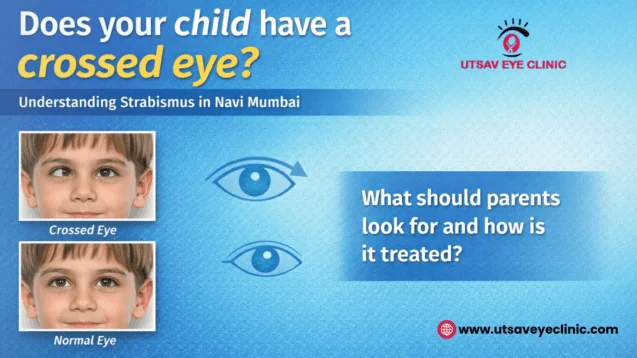
A squint, medically known as strabismus, is a common pediatric vision condition where the eyes do not align properly. One eye may turn inward (esotropia), outward (exotropia), upward (hypertropia), or downward (hypotropia), while the other eye focuses straight ahead. This misalignment can be constant or intermittent, meaning it comes and goes, especially when the child is tired, unwell, or focusing on near objects. Strabismus affects approximately 3% to 4% of children, and it is a leading cause of preventable visual impairment in childhood. In a normal visual system, both eyes point at the same spot, and the brain merges the two slightly different images into a single three-dimensional (3D) picture. When eyes are misaligned, the brain receives two different images. To avoid double vision, the young brain automatically ignores the image from the misaligned eye. Over time, this neglect can halt visual pathway development, leading to lazy eye (amblyopia) or lack of depth perception (stereopsis).
Common Signs and Symptoms to Watch For
Detecting a squint in young children can sometimes be challenging, particularly if the misalignment is subtle or only happens occasionally. Parents should watch for the following common warning signs:
• Visible eye turn: One eye clearly drifting in a different direction from the other.
• Frequent squinting or blinking: The child closes one eye in bright sunlight or squints when trying to focus on distance objects.
• Head tilting or turning: Tilting the head to one side or turning the face to compensate for double vision and align the eyes.
• Poor depth perception: Clumsiness, frequently bumping into furniture, misjudging steps, or difficulty catching a ball.
• Complaining of eye strain or headaches: Particularly in school-going children after reading or computer work.
It is important to note that during the first three months of life, a baby's eyes may occasionally cross or drift due to developing eye coordination. However, any eye turn that persists after three to four months of age is abnormal and requires an immediate evaluation by a pediatric ophthalmologist.
Why Early Detection and Treatment are Critical
A child's visual system is highly adaptable but undergoes rapid development that stabilizes by age 8 or 9. If a squint is left untreated during this critical developmental window, the visual pathway between the misaligned eye and the brain will not mature properly. This results in amblyopia (lazy eye), a condition where the eye has permanently reduced vision that cannot be corrected with glasses later in life. Furthermore, children with untreated strabismus will fail to develop stereopsis, or normal binocular 3D vision, which is essential for tasks like driving, sports, and certain professions (such as surgery or aviation). Early intervention at Utsav Eye Clinic using corrective glasses, patching, or muscle surgery can successfully restore alignment and protect your child's vision.
How to Check for a Squint at Home
While a home check cannot replace a professional exam, parents can use a simple light test (Hirschberg test) to look for signs. Shine a small flashlight gently toward your child's eyes from a distance of about two feet while they look directly at the light. Look at the reflection of the light (corneal light reflex) on the pupils of both eyes. In normally aligned eyes, the light reflection should be in the exact center of both pupils. If the reflection is in the center of one pupil but shifted toward the edge in the other, it indicates a corneal light reflex asymmetry and a likely squint. If you notice this, you should schedule a consultation.
Pediatric Eye Exams and Treatments at Utsav Eye Clinic
At Utsav Eye Clinic, our pediatric ophthalmologist, Dr. Anand Kumar, performs specialized child-friendly examinations to diagnose squints, even in infants and toddlers. Treatment options vary depending on the type and severity of the squint:
1. Correcting Refractive Errors: Many squints, especially accommodative esotropia, are caused by farsightedness (hyperopia) and are fully corrected simply by wearing the right prescription glasses.
2. Patching (Occlusion Therapy): Covering the stronger eye with a patch for a few hours daily to force the brain to use and strengthen the weaker, misaligned eye.
3. Prism Lenses: Special lenses added to glasses that bend light rays to help align the double images.
4. Squint Muscle Surgery: If glasses and patching do not fully align the eyes, a safe daycare procedure is performed to strengthen or weaken the eye muscles to restore normal visual alignment.
Frequently Asked Questions (FAQ)
Can a child outgrow a squint?
No. It is a myth that children outgrow squints. A squint is a medical condition that requires evaluation and treatment by a pediatric eye specialist. Left untreated, it can lead to permanent vision loss (lazy eye).
At what age can squint treatment start?
Squint treatment can start at any age, even in infants as young as 3 to 6 months. The earlier treatment begins, the higher the chance of restoring normal 3D vision and preventing amblyopia.
Is squint surgery painful for a child?
No. Squint surgery in children is performed under general anesthesia, so the child feels no pain during the procedure. After surgery, there may be mild scratchiness or redness for a few days, which is managed with comforting eye drops.
What is the success rate of pediatric squint surgery?
Squint surgery has a very high success rate, typically over 85% to 90% for restoring cosmetic alignment and binocular visual potential. Some complex cases may require more than one muscle adjustment.
How does patching help treat a squint?
Patching does not straighten the eyes, but it treats the lazy eye (amblyopia) associated with the squint. By covering the good eye, it forces the brain to develop visual pathways for the squinting eye.
Can glasses alone correct a squint?
Yes, in certain types of squint like accommodative esotropia (inward turn caused by focusing effort), wearing the correct glasses can fully straighten the eyes without surgery.

MBBS, MS (Ophthalmology), Fellowship in Pediatric Ophthalmology & Strabismus (USA). Chief Surgeon & Director at Utsav Eye Clinic.