
Squint (Strabismus) in Children — Early Diagnosis & Treatment in Navi Mumbai
Squint (strabismus) in children is a treatable condition where the eyes do not point in the same direction. Early treatment is essential because untreated squint can lead to amblyopia (lazy eye), causing permanent vision loss in the affected eye. At Utsav Eye Clinic in Kharghar, Navi Mumbai, Dr. Anand Kumar — a fellowship-trained paediatric ophthalmologist and strabismus specialist — provides comprehensive squint evaluation and treatment for children from infancy to adolescence.
What is Squint in Children?
Strabismus, commonly known as a squint, is a condition where one or both eyes turn inward, outward, upward, or downward. Rather than both eyes working together to look at the same object, one eye fixates on the object while the other deviates.
Squints are categorized by the direction of the eye turn:
- Esotropia: One or both eyes turn inward (towards the nose).
- Exotropia: One or both eyes turn outward (away from the nose).
- Hypertropia / Hypotropia: One eye turns upward or downward relative to the other.
Warning Signs of Squint in Babies and Young Children
Children often do not complain about vision problems because they assume their vision is normal. Parents should look for these warning signs:
- One eye turns in, out, up, or down, especially when the child is tired or ill.
- The eyes do not appear to move together synchronously.
- The child closes or covers one eye, particularly in bright sunlight.
- Frequent head tilting or face turning to try and see objects clearly.
- Frequent eye rubbing or squinting of the eyelids to focus.
- Parents notice a "white reflex" in the pupil in flash photographs. (Note: A white reflex can indicate other serious conditions and requires urgent evaluation).
- Clumsiness or poor depth perception, potentially indicating reduced vision in one eye.
Why Early Treatment Matters — The Amblyopia Risk
The visual system continues to develop rapidly during childhood, typically until the age of 7 to 8 years. This is considered the critical period for visual development. If a child has a squint, the brain receives two different images. To avoid double vision, a child's highly adaptable brain will begin to suppress or ignore the image from the deviated eye.
If left untreated, this persistent suppression prevents the visual pathways from developing correctly, leading to a condition known as amblyopia (lazy eye). Once the critical period of visual development passes, amblyopia becomes significantly harder, and sometimes impossible, to treat. Early intervention is the key to preventing permanent vision loss and enabling the child to develop strong binocular vision (3D vision).
Treatment Options for Children
Squint treatment is tailored to the child's specific diagnosis. Dr. Anand Kumar employs a step-by-step approach:
- Glasses: Some forms of squint, such as accommodative esotropia (an inward turning of the eye caused by significant farsightedness), can be fully or partially corrected simply by wearing the correct prescription glasses.
- Patching (Occlusion Therapy): If amblyopia has developed, the child will need to wear a patch over the stronger eye for a prescribed number of hours each day. This forces the brain to use and strengthen the visual pathways of the weaker eye.
- Atropine Drops: For children who struggle with patching, atropine eye drops can be used in the stronger eye to temporarily blur its vision, similarly forcing the weaker eye to work.
- Vision Therapy / Orthoptics: Specific, structured eye exercises may be recommended for certain types of intermittent squints to strengthen eye coordination.
- Surgery: When non-surgical methods are insufficient to align the eyes, or if the squint has a structural, muscular cause, squint surgery is recommended to physically realign the extraocular muscles.
At What Age Is Squint Surgery Done in Children?
The recommended age for surgery depends entirely on the type and severity of the squint. For instance, in babies born with infantile esotropia (a severe inward turn present from birth), surgery may be performed as early as 6 to 18 months of age to establish binocular vision early on.
For accommodative squints, a thorough trial of glasses and amblyopia therapy will be completed first. If surgery is required, it is generally performed between 2 and 5 years of age—safely within the critical visual development window. While there is no strict upper age limit (surgery can realign the eyes at any age), intervening early provides the best opportunity to prevent permanent amblyopia and restore healthy depth perception.
What Happens During Pediatric Squint Surgery?
Paediatric squint surgery is a safe, highly routine procedure designed to correct muscle imbalances. Here is a general overview of the steps involved:
- The child is admitted as a day-care patient, meaning no overnight stay is required.
- The procedure is performed under safe general anaesthesia administered and monitored by a dedicated paediatric anaesthesia team.
- The surgeon utilizes a micro-incision fornix technique, operating through a hidden incision in the conjunctiva. The eye is never removed from the socket, and there are no external skin scars.
- The targeted extraocular muscles are carefully repositioned (weakened or strengthened) to correct the specific angle of deviation.
- The surgical portion of the procedure typically takes 30 to 60 minutes.
- The child wakes up comfortably in the recovery room and is usually ready to be discharged home within 2 to 4 hours.
- Prescription antibiotic and steroid eye drops are started the same day to promote clean healing.
Recovery After Pediatric Squint Surgery
Children tend to bounce back quickly after squint surgery. Below is a standard recovery timeline. For more details, visit our comprehensive squint surgery recovery guide.
- Days 1–3: Expect mild redness, teary eyes, and light sensitivity. The eyes may feel slightly scratchy. Keep the eye area clean and administer drops as prescribed.
- Days 3–5: Discomfort usually subsides, and most children can return to school or nursery. Swimming should be strictly avoided.
- Weeks 1–4: Redness gradually fades. The alignment of the eyes begins to stabilise as the brain adapts to the new muscular balance.
- 6–12 Weeks: Complete surface healing is achieved. The final alignment is assessed, and any required patching or glasses wear is continued based on the child's needs.
Squint vs. Lazy Eye (Amblyopia) — Are They the Same?
Squint (Strabismus)
Lazy Eye (Amblyopia)
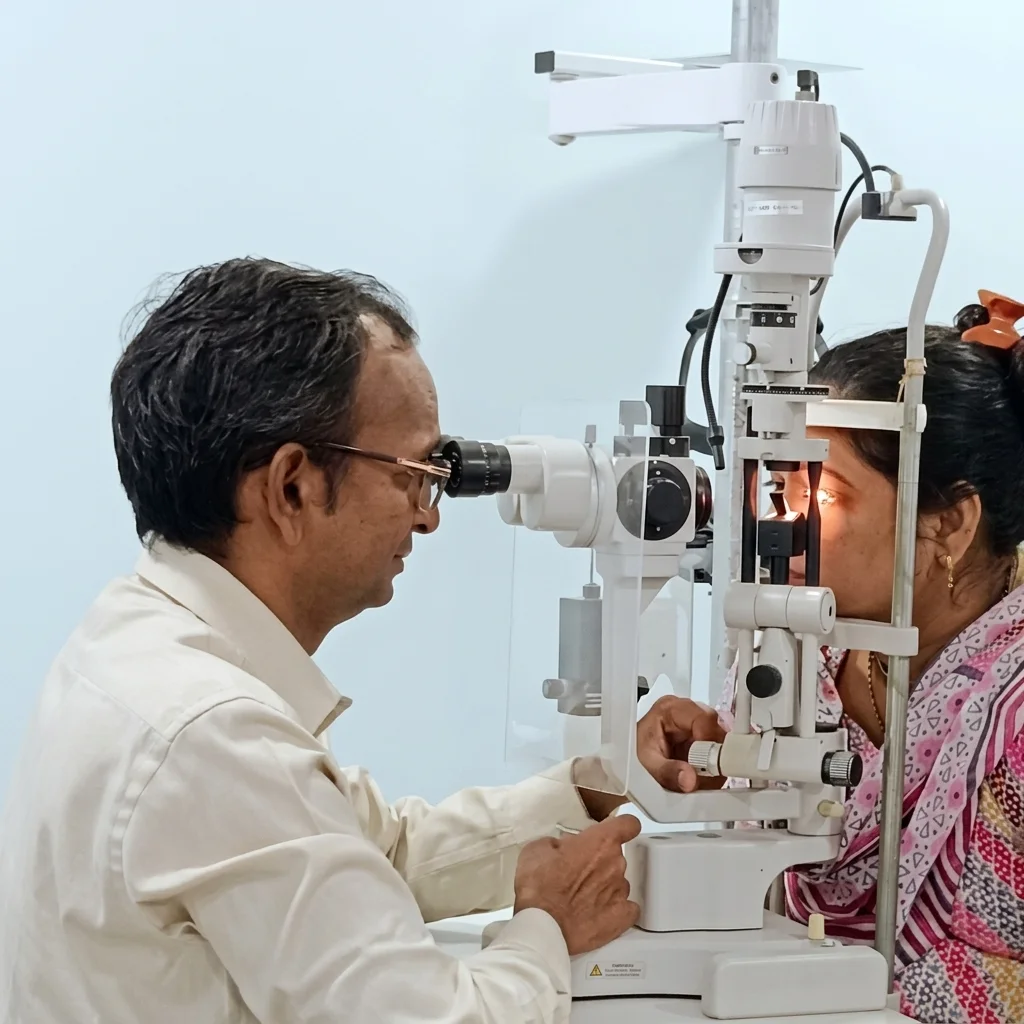
About Your Paediatric Squint Specialist
Serving Families Across Navi Mumbai & Mumbai
Located in Sector 21, Kharghar, Utsav Eye Clinic serves children and families seeking specialized pediatric eye care from across the region, including Panvel, Vashi, Belapur, Nerul, Thane, and South Mumbai. We provide guidance on surgery costs and can assist with insurance reimbursement assistance where applicable.