
Squint (Strabismus) Treatment for Adults — Can It Be Fixed at Any Age?
Squint (strabismus) is fully treatable in adults at any age. Adult strabismus surgery, performed as a day-care procedure under local anaesthesia, repositions the extraocular eye muscles to realign the eyes. At Utsav Eye Clinic in Kharghar, Navi Mumbai, Dr. Anand Kumar uses the micro-incision fornix technique and adjustable suture method to achieve precise, stable eye alignment in adult patients.
What is Adult Squint (Strabismus)?
Strabismus in adults occurs when the eyes do not properly align with each other. One eye may look straight ahead, while the other turns inward (esotropia), outward (exotropia), upward (hypertropia), or downward (hypotropia). Unlike children who often adapt by unconsciously ignoring the image from the turned eye, adults often struggle significantly because their visual system is already fully developed.
Adult strabismus can originate in two primary ways. Some adults have had a misaligned eye since childhood that was left untreated or recurred over time. Others develop a squint entirely in adulthood due to underlying conditions such as thyroid eye disease, cranial nerve palsies, neurological events (like a stroke), or physical injury to the eye muscles. The impact of adult strabismus is profound, carrying both severe functional and cosmetic consequences.
Why Adults Seek Squint Treatment
There is a common myth that treating adult strabismus is purely for cosmetic reasons. This is completely false. Realigning the eyes has real, tangible functional benefits. Adults frequently seek squint treatment to address:
- Double Vision (Diplopia): This is the most common and debilitating functional complaint, drastically affecting quality of life.
- Eye Strain and Fatigue: Constant effort by the brain and eye muscles to realign the eyes or suppress a second image leads to chronic strain.
- Abnormal Head Posture: Patients often tilt or turn their head continuously to find a "sweet spot" where they don't see double, leading to severe neck pain.
- Social Confidence: Eye contact is vital for human connection. Misaligned eyes can severely impact self-esteem and confidence in social interactions.
- Driving Safety & Occupational Requirements: Poor depth perception and double vision can make driving dangerous and hinder specific occupational tasks.
Adult vs Paediatric Squint Treatment — Key Differences
| Factor | Adults | Children |
|---|---|---|
| Anaesthesia type | Usually local anaesthesia with monitored sedation | Always general anaesthesia |
| Surgical goals | Eliminate double vision, improve cosmesis, restore binocular vision if possible | Preserve visual development, prevent amblyopia (lazy eye), establish binocularity |
| Amblyopia risk | None (visual pathways already developed) | High (brain will suppress the turning eye) |
| Recovery | Slightly more initial discomfort; faster return to normal daily tasks (office work) | Very fast physical bounce-back; require close long-term visual monitoring |
| Adjustable sutures | Frequently used for precise post-operative fine-tuning | Rarely used (difficult for young children to cooperate) |
Treatment Options for Adults Without Surgery
Not every adult with strabismus requires surgery immediately. Depending on the cause and extent of the misalignment, non-surgical approaches can be highly effective in managing symptoms:
- Prism Glasses: Special lenses can bend light to merge two images into one, effectively treating mild double vision without altering the eye muscles.
- Botulinum Toxin (Botox) Injections: Used in selected cases, Botox can temporarily paralyze an overactive eye muscle, allowing the opposing muscle to pull the eye straight. This is often used for acute nerve palsies.
- Vision Therapy / Orthoptics: Specific eye exercises can strengthen the eye's focusing and coordination systems, useful primarily for conditions like convergence insufficiency.
Squint Surgery for Adults — How It Works
If non-surgical methods are insufficient, squint surgery provides a definitive mechanical correction. The procedure involves the following steps:
- Pre-operative Assessment: A comprehensive orthoptic evaluation is conducted to measure the exact degree of deviation in all gaze positions.
- Day of Surgery: The procedure is performed under local anaesthesia with monitored sedation (MAC). You will be relaxed and comfortable, but awake.
- Micro-Incision Fornix Technique: Dr. Anand Kumar places small incisions in the natural folds of the conjunctiva (the clear membrane covering the white of the eye) ensuring the incisions remain hidden and minimizing visible scarring.
- Muscle Adjustment: The targeted extraocular muscles are either detached and moved further back (recession to weaken) or shortened (resection to strengthen) to rebalance the eye.
- Adjustable Suture Placement: If indicated, a special slip-knot suture is used to secure the muscle.
- Same-Day Fine-Tuning: For patients with adjustable sutures, alignment is checked after surgery. Under simple anesthetic eye drops, the knot can be adjusted to perfect the alignment before it is permanently tied off.
- Discharge: Patients go home the same day with a prescription for antibiotic and steroid eye drops.
To learn more about the financial aspect, review our guide on the cost of squint surgery.
The Adjustable Suture Technique — A Precision Advantage
The adjustable suture technique is particularly valuable in adult strabismus surgery. Because the adult brain is less adaptable than a child's, achieving millimeter-perfect alignment is critical for eliminating double vision. This technique allows the surgeon to perform the initial surgery, let the patient awaken fully to assess the visual alignment in real-time, and then make micro-adjustments to the muscle tension. It provides an unmatched level of precision and reduces the likelihood of requiring a second operation.
Recovery After Adult Squint Surgery
Recovery is generally straightforward. In the first 1 to 3 days, it is normal to experience redness, a scratchy sensation (like sand in the eye), and mild light sensitivity. Most adults can resume desk work or normal daily activities within a week. The alignment stabilizes between 2 to 4 weeks, with complete tissue healing taking about 6 to 12 weeks. For detailed timelines and aftercare instructions, read our full recovery after squint surgery guide.
About Your Squint Specialist
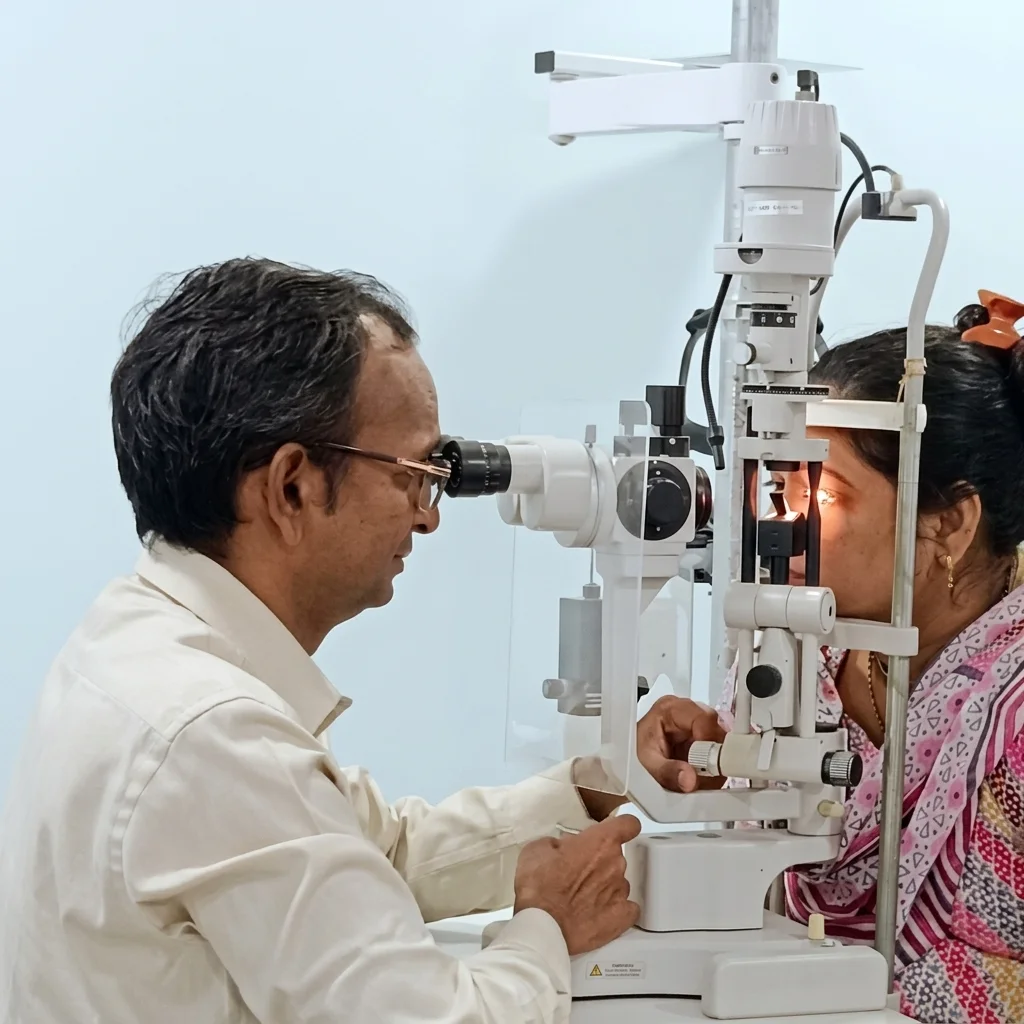
Serving Patients Across Mumbai & Navi Mumbai
At Utsav Eye Clinic, we proudly provide specialized strabismus care to adult patients from Kharghar, Panvel, Vashi, Belapur, Nerul, Thane, and South Mumbai, ensuring access to world-class treatment without long travel times.